

Creative Rituals for Transition | Part 2
A Mark a Day: Making Time Visible / Part 2 of 3 of the "Creative Rituals for Transition" series.

The majority of us live with a keen desire to remain free from tension. Regardless of the infeasibility of this endeavor, we recoil at the thought of being pressed in by unfavorable or nebulous circumstances. Yet, circumstances that force us to be present to a seemingly untenable now perpetually arise, placed temporality urging us to lean into an unabashed present.
In How to Inhabit Time, author and philosopher James K.A. Smith writes about “the fantasy of linear time,” stating:
“Linear progression is not how we experience time, either individually or collectively. Our experience of time is one of ‘duration’ [...] Past and present permeate each other; the now is porous.”
This porous now is one in which we must face the repercussions of the past while tending to the possibilities of the future. The question becomes whether we can imagine and work towards a future that neither denies the impossibility of attaining a sustained collective sense of perfection nor gives into a nihilistic sensibility that wonders if any true sense of “good” can ever be cultivated. This tension—perhaps another word for the “present”—is perpetual and undeniable. Our now is what we have, yet our past and future overlap, influencing our choices and shaping our desires.
Thanks to Greg Lookerse’s essay, “Art is, Just Like, Relative, Man,” I recently discovered John Cage’s orchestral installation As Slow As Possible. Using an organ and sandbags, As Slow As Possible is set to play a single song composed by Cage across the span of 639 years. In responding to this work, Lookerse asks, “who is this music for? [...] To us, mere humans, most of Cage’s work is hardly music. But what if there is someone with a different perspective?” Lookerse then quotes Andrew Klavan’s book, The Kingdom of Cain:
“Eternity is not a long time, it is all time, and it is impossible for mortal man to imagine. In eternity, for instance, you may not be reconnected to your lost loved ones, you may find you never lost them at all. In eternity, you may not find that God makes good out of evil, you may find that it was always good, you simply did not see it complete.”
Can you imagine a reality in which our lives are mere notes of a much longer song that only God can fully hear? This sort of metaphysical, macro-level thinking can be difficult to grasp, but if we could hold the thought in mind for even a moment, perhaps the brevity of our lives may come into clearer perspective.
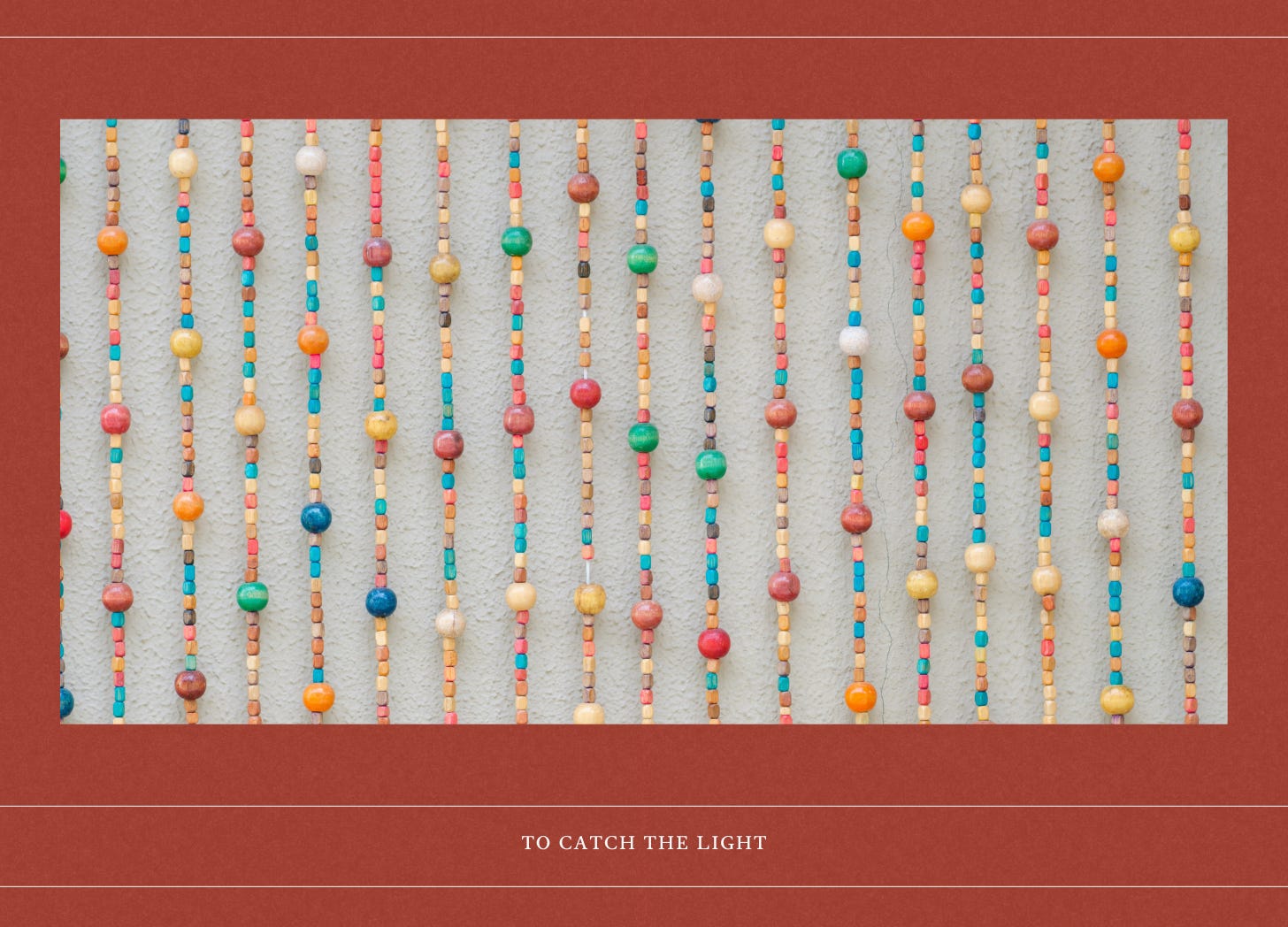
Still, even if each of us is only a single bead on a long, threaded chain, that does not reprieve us from the felt realities of our tangible and immediate lives. Even with a broadened perspective, how do we navigate our singular and collective nows? How do we keep in step with what our present times require of us? How do we place ourselves within the continuum of time, especially when we are moving between shifting realities?
To ground this philosophical exploration, I am happy to turn to the physical comfort of tactile art. Ever since I came across her feed on Instagram, I’ve been inspired by Jessie Modine Young’s fiber art project, “A Woven Year.” Every day for an entire year, the fiber artist created a new weaving. For any of you who have ever woven a piece of cloth before, you know that the task, while soothing, can be incredibly time-consuming. Yet, Young chose to give herself over to the process.
Looking through the collection online, I notice subtle shifts in Young’s work over time. There are undeniable visual patterns in Young’s materials, color range, and weaving techniques, yet there are clues as to how the project may have progressed for the artist internally. In describing the process of weaving “A Woven Year,” Young’s site uses phrases like “visual process,” “a meditative act of care and record-keeping,” and “emotional anchor.” I am drawn to the last two phrases in particular, and they are inspiring the next creative practice in the series “Creative Rituals for Transitions.”
When I read that Young referred to “A Woven Year” as an “abstract journal,” I was curious about how Young’s interior life may have changed over the span of the 365 days it took her to complete the project. Showing up daily to a set of materials and a creative practice can be grounding and meditative. Spending time with the same practice day after day undoubtedly changes you.
The creative ritual below is centered on the idea of repeated, daily practice as a way of marking time. The thought behind this is that when you are navigating liminal space, daily mark-making can be a way to visually create scaffolding for characteristically unstructured seasons.
Though Young chose to engage in the same practice for a full year, you may not have a clearly distinguished amount of time in mind, and this is fine. Try engaging in the practice until you feel you have moved through the liminal season and into a place of clarity. Alternatively, if you are navigating something that may never have a sense of resolution or clarity (like the unexpected loss of a loved one, for example), set your own boundary of time. One to three months may be a workable duration, offering ample time for the practice to take root while also preventing the practice from rolling on indefinitely.
A Mark a Day: Making Time Visible
The unmooring process of moving through liminality—navigating unnamed spaces filled with uncertainty and characterized by unmarked time—can be anxiety-provoking. This practice helps you create a vessel that can hold your unfolding story, a space that witnesses what is emerging within and around you in its own time. It creates a gentle rhythm you can return to as you seek to listen for the new patterns developing in your life.
What You’ll Need
Your chosen medium (select one):
Watercolor or acrylic paints
Markers or colored pens
Embroidery thread and needle

Beads and thread or yarn
Any other mark-making materials that call to you
A container for your marks:
Single large sheet of paper or canvas
Sketchbook or journal
Piece of fabric
Time: 1-15 minutes daily
Suggested Duration: 1-3 months, or until you feel you’ve moved through the liminal season.
The Practice
1. Choose your medium and container
Select materials that feel right for this season. Watercolor might offer fluidity and create a sense of discovery through its characteristic unpredictability. Markers might offer clarity and boldness. Fabric and thread might offer texture and slowness.
Choose a single container—one canvas, one journal, one piece of fabric—that will hold all your daily marks. Imagine this as the vessel carrying your story forward.
2. Determine your daily time
Decide whether you’ll practice in the morning or evening:
Morning: Orient your day with intention, marking what you want to carry into the hours ahead.
Evening: Reflect on what transpired, capturing the day’s essence before releasing it.
There is no right or wrong time, but consistency helps your mind and body tune into the rhythm you are cultivating.
3. Make your daily mark
Each day, return to your vessel and make a single mark. This is where you can get creative:
Option A: Uniform marks
Same color, same shape, same size each day.
At the end of the process you’ll have a visual form for the duration of time you moved through. The accumulation becomes the story—individual marks may not be significant, but the collection demonstrates that you showed up daily and eventually moved through your liminal space.
Option B: Variable marks
Select colors based on how you’re feeling or vary each mark’s shape or length based on the day’s intensity. You can also try altering stitch patterns to represent the complexity of your thoughts that day.
Let each mark tell that day’s particular story.
4. Practice without judgment
Some days the mark will feel significant. Some days it will feel mechanical. Some days you’ll forget and need to make two marks the next day. All of this is fine. Ultimately, this practice is about showing up, not achieving clock-like perfection.
5. Witness the accumulation
As days turn into weeks, notice what emerges. Do you see patterns in your thoughts or feelings? Visually, do you notice clusters of similar marks or shifts in color or intensity? The vessel is showing you something about this season—not through any single day, but through the collection of days experienced.
An Alternative: Flourish Cards as Daily Mark-Making
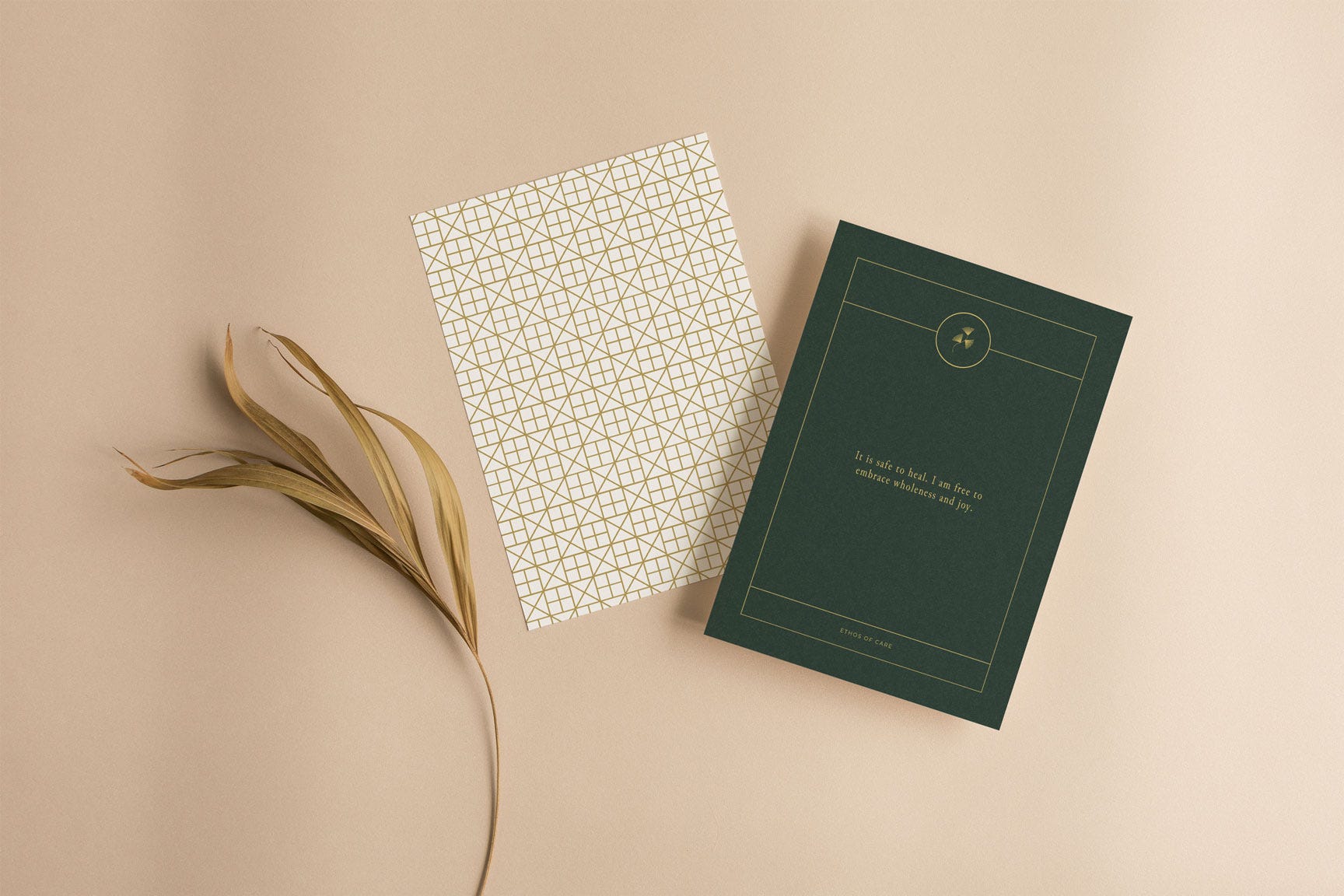
If starting with a blank canvas feels overwhelming, or if you want a structured container for your daily practice, Flourish Meditation Coloring Cards offer another approach to this ritual. I designed these cards specifically to help people during times of stress and transition.
How to use Flourish Cards for this practice:
1. Choose one card from the collection that speaks to you. Read the affirmation. This becomes your anchor—the direction you’re moving toward, even when the path feels unclear.
2. Return to the same card daily for 5-15 minutes. Fill in one section of the design each day.
3. Notice the accumulation over days and weeks. The pattern gradually filling in becomes visual evidence of time passing, of showing up, of moving through the liminal space one day at a time.
4. When you’ve finished coloring in the card’s design, the practice naturally concludes. This built-in endpoint can be helpful if open-ended practices feel too uncertain. The completed card becomes an artifact of this threshold season.
Why this works:
The structure is already provided (the pattern), so you’re freed from “what do I make?” paralysis. The affirmation grounds you daily in intention. The bilateral movement of coloring (hand moving rhythmically across the page) may help calm your nervous system while you mark time, a benefit that research suggests may offer support during transitions.[1]
You’re not just marking time—you’re also reinforcing, daily, the direction you want to move.
[1] Research suggests bilateral hand movements may support nervous system regulation and emotional processing. See: Riley et al. (2013). British Journal of Occupational Therapy.
After the Practice
When you feel you’ve completed the ritual—whether after the predetermined time or when you sense the liminal season shifting—spend time with your completed vessel.
Reflect:
What was the overall process like for you?
Did you enjoy it? Find it relaxing? Stressful to maintain?
Did your marks change over time? If so, what collective story do they tell?
What did showing up daily reveal to you about this season of transition?
Consider journaling about your experience.
Choose your next step:
Keep it: Frame or display your visual story of mark making as a reminder of your resilience. Allow it to be evidence that you moved through uncertainty one day at a time.
Release it: If the practice served its purpose and you are ready to let it go, honor it first. Perhaps say, “I honor what was and I now release it as I make room for something new to emerge,” before disposing of it mindfully.
Transform it: Choosing to keep and alter your piece allows the practice to continue in cycles. For instance, some people photograph their mark-making vessels to remember the process, then choose to paint over them to start anew. This approach honors the process while creating space for what comes next.
For Groups
If practicing with others, have each person create their own daily mark vessel. Then, meet weekly or bi-weekly to:
Share what you’re noticing in your patterns
Witness each other’s process without judgment
Discuss what daily practice is teaching you about time, presence, and transition
There is something powerful about a community all marking time together—each person’s vessel is unique, but the practice is shared.
In facilitated workshops, I guide groups in exploring additional dimensions: how different materials affect the experience, what happens when we make marks together in real time, and how to use the completed vessels as jumping-off points for deeper integration work. If you’d like to explore group facilitation, feel free to reach out.
A Note on Consistency
You may miss days. If or when you do, notice what that brings up for you.
Does missing a day feel like failure? That’s worth examining—perfectionism often surfaces in daily practices.
Can you make two marks the next day without judgment? That’s the practice within the practice.
Please remind yourself that this isn’t about achieving a perfect record. This practice is about returning, again and again, to the simple act of marking time—making the invisible passage of days visible, tangible, held.
If you try this ritual, I’d love to hear about your experience. What medium did you choose? What did the daily rhythm teach you? What surprised you about seeing time accumulate?
Drop a comment below.
And if you’re navigating a major transition right now, please know that you are not alone in the uncertainty. One mark at a time, you are moving through.
"To Catch the Light" explores the interweavings of creativity, spirituality, and healing.
This is so beautiful